
Publishing Thursday 29 October 2026
Build. Transform. Last.
Build. Transform. Last. is out now.
Get Your CopyOut now · Paperback, hardback and ebook
How can we design healthcare services so they are more likely to succeed, sustain beneficial outcomes and be capable of scale?
That question drove three decades of practice. Build. Transform. Last. is the answer — and the practical philosophy for making it happen.
Available now in paperback, hardback and ebook.
See what's inside →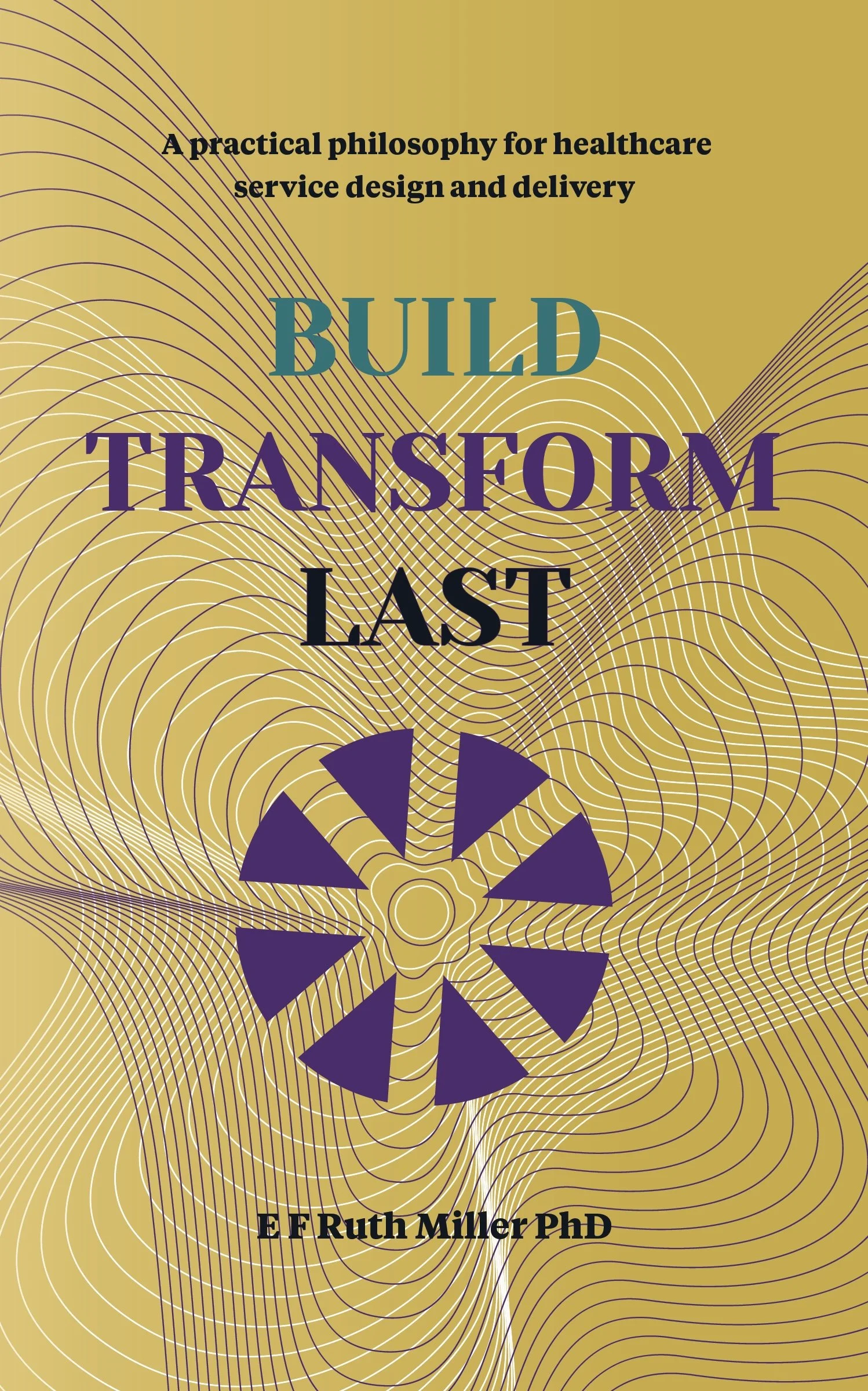
Praise for the book
“This book by Dr Ruth Miller is not only timely in our European settings, but also of global interest. At this moment, it is difficult to find a country that is not seeking to transform its health care system, but many are jumping to what are apparently structural ready-made solutions without stopping to reflect. This mental trap is even more visible as the speed of events, technological, clinical and environmental, escalates at unprecedented pace.
The changes required today are the most complex since the inception of our health care systems many decades ago. It therefore requires different thinking for leaders and health professionals. The book also reflects on the other key global trend for leaders: the need for more local freedom, more licence to innovate, and collaboration among those at the delivery level, and how to scale up those innovations with patient pathways in mind, not structural reorganisations.
Since everyone, whether at the micro or macro level, is in one way or another managing change, I encourage everyone to read it!”
Professor Rafael Bengoa
Former Minister for Health, Basque Government; Northern Ireland review “Systems, not Structures”
The problem
Good services disappear. They should not.
Healthcare professionals are not short of commitment, expertise or effort. What too many services are short of is the architecture to last. The evidence was never built in. The problem was never properly defined. The pathway was never mapped before a solution was proposed.
The result is familiar.
- A service that worked quietly disappears when funding ends or a key person moves on
- An innovation never moves beyond pilot status, despite clear results
- Evaluation is requested after implementation — and there is no baseline data to work with
- Significant effort is spent solving the wrong problem, because the right one was never clearly defined
- The evidence to defend a service in a funding review simply does not exist — not because nobody cared, but because nobody built it in at the start
This is not a failure of people. It is a failure of architecture.
What the book offers
A different way of thinking before you decide what to do
Build. Transform. Last. is a practical philosophy for healthcare service design and delivery. It does not replace project management, implementation science, quality improvement or service design. It operates upstream of all of them — shaping the questions asked, the assumptions challenged, and the clarity achieved before any method is selected.
"How can we design, deliver and evaluate healthcare services so they are more likely to succeed, sustain beneficial outcomes and be capable of scale?"
BTL is organised around three interconnected stages, expressed through eight principles. Together they address the full arc of a service: from first understanding the problem, through design, implementation and learning, to sustainability and scale.
The eight principles
Building blocks that consistently contribute to successful services
Each principle is supported by practical actions that can be adapted across healthcare settings. Together they provide a structured yet flexible approach to designing services that succeed, sustain beneficial outcomes and scale.
See the Whole Pathway
Assume Nothing
Design With Those Closest to the Work
Design Evaluation at the Beginning
Ownership Drives Adoption
Implementation Is the Beginning, Not the End
Evidence Secures the Future
Repeat, Scale, Sustain
Inside the book
Written for practitioners, not for academic departments
The people this book was written for are in wards, community and hospital pharmacies, outpatient clinics, GP practices, commissioning meetings and system-level roles. They are doing the work. They deserve a methodology that works as hard as they do.
Why services struggle to last
An evidence-informed account of the recurring patterns that prevent good services from surviving — and what lies beneath them.
The BTL philosophy in full
What BTL is, how it emerged, where it operates — and exactly what it is not.
All eight principles explored in depth
Each principle examined in its own chapter, with reflection questions designed to be applied to a real service or programme.
The Millbrook case study
A fictional but realistic integrated healthcare service, threaded through every principle chapter to show what BTL looks like in practice.
The Evidence Future Ready Model
The organisational capability model that helps teams assess and strengthen their readiness to apply BTL consistently.
The BTL Starter Toolkit
Practical question sets for each principle, ready to use with a live service or project.
Design services that succeed, sustain and scale.
Available now in paperback, hardback and ebook.
E F Ruth Miller PhD · EFRM Consulting Ltd · efrmconsulting.com